




2026 Legislative Session Recap: Significant Investments and Structural Innovations for Affordable Housing
SF Gate: Newsom Signs New Affordable Housing Bill in Oakland
July 14, 2026
KQED: Californians Pass Homeownership, Affordable Housing Bonds
November 4, 2026
The final year of the Newsom administration was generally another good year for housing with important specific wins for affordable housing and the Bay Area. NPH worked closely with our members, partners, and champions in the Legislature to help launch the new California Housing and Homelessness Agency, secure meaningful investments in state and local housing solutions, and pass our sponsored legislation that addresses challenges and improves systems within affordable housing.
The New State Agency Elevates Housing
The biggest structural change for housing in a generation took effect on July 1: the new California Housing and Homelessness Agency (CHHA). For the first time, California has a cabinet-level secretary dedicated solely to housing, homelessness, and civil rights.
While the CHHA itself was approved last year, it was this session’s AB 179 that directed resources to the agency — administering a sizable portion of the Affordable Housing and Sustainable Communities (AHSC) program and receiving a large allocation of the private activity bonds administered by CDLAC. With this new agency and the creation of the Housing Development and Finance Committee (HDFC) underneath it, California will reduce the complexity of affordable housing finance, moving closer to a “one-stop shop” than ever before. We thank Secretary Tomiquia Moss for her leadership and vision for the state’s housing programs.
The $11.25 Billion Housing Bond Heads to Voters
After years of work on another statewide housing bond, the Legislature and the Governor placed Proposition 1, an $11.25B housing bond, on the November ballot. Prop 1 would authorize $5.1B for the Multifamily Housing Program (MHP), an additional $1.15B in Supportive Housing MHP, $750M to the Portfolio Reinvestment Program, and many other programs. The scale of Prop 1 is significant, representing a two-fold increase in funding from the voter-approved 2018 housing bonds.
NPH is grateful for the leadership of Assemblymember Buffy Wicks and Senator Christopher Cabaldon, who championed this bond for years, as well as the leadership of both houses, Senate Pro Tempore Limón and Speaker Rivas, and Governor Newsom. Without them, this historic bond would not have been possible.
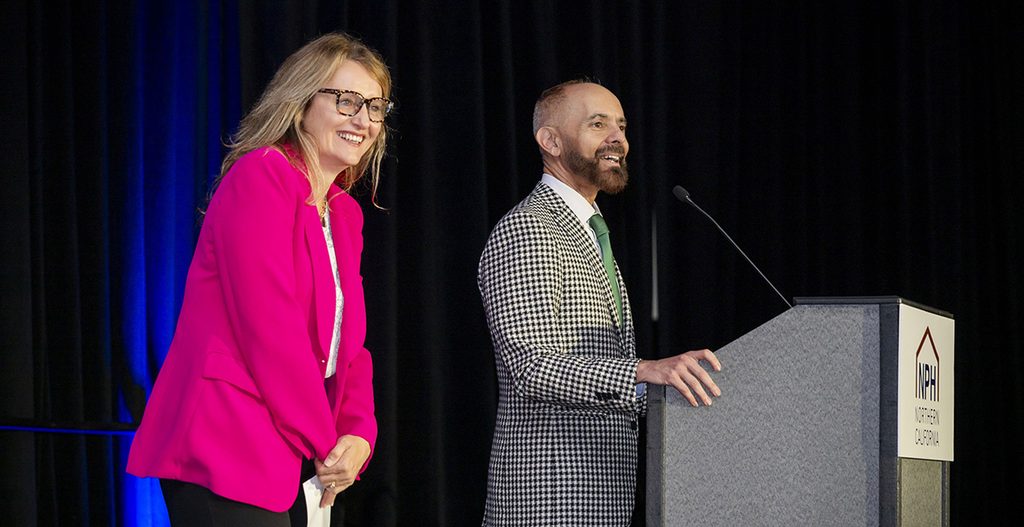
Asm. Wicks and Sen. Cabaldon at the NPH Conference, Sept 24, 2026. Photo courtesy of Shellee Fisher.
The State Budget Invests $1.7 Billion in Housing
NPH joined with a statewide coalition to advocate for increased investments in this year’s budget. Despite a difficult federal environment, the Legislature and the Governor passed an additional $1.7B in one-time funding for housing and homelessness programs. This 52% increase over last year was possible in part thanks to stronger state tax revenue than expected. These critical investments will continue our progress in addressing housing affordability and homelessness across the Bay Area, including:
- $900M for the Homeless Housing, Assistance and Prevention (HHAP) Program,
- $500M for the State Low-Income Housing Tax Credit (LIHTC), and
- $200M for the Multifamily Housing Program (MHP)
Bay Area Legislators Champion the Bay Area Housing Finance Authority
This session also saw a critical investment in region-specific funding, with NPH’s successful effort to secure nearly $7 million for the Bay Area Housing Finance Authority (BAHFA).
During the State budget process, NPH organized a joint letter representing local organizations across the state requesting funding for California’s regional housing finance authorities, including BAHFA. While we were unsuccessful at securing funding in the larger state budget, a round of local earmarks were possible thanks to continuing strong tax revenue. We thank Assemblymember Buffy Wicks, Senator Jesse Arreguín, and Senator Josh Becker for their leadership and their commitment to BAHFA. Their offices dedicated nearly $7M to BAHFA’s work across the Three P’s, the successful Doorway platform, and a mixed-income financing program.
NPH-Sponsored Legislation Addresses Affordable Housing Challenges
NPH worked with our partners and legislators to shape and secure several pieces of priority legislation that help address challenges and improve systems within affordable housing. In what was likely his last round of bill signings as California governor, Governor Newsom signed two NPH-sponsored bills:
- AB 2146 (Stefani) tasks the California Interagency Council on Homelessness (Cal ICH) with a comprehensive statewide study of the coordinated entry system and its role in connecting individuals and families experiencing homelessness to affordable housing. NPH’s framework, developed with Enterprise Community Partners in the recent “Strengthening Coordinated Entry in California,” offers a starting point that has been endorsed by more than 30 organizations. We look forward to supporting Cal ICH’s study with our members’ experience in operating supportive housing. AB 2146 was co-sponsored by NPH and Housing California. We thank Assemblymember Catherine Stefani for her deep commitment to moving this piece of legislation forward and improving housing access for our most vulnerable community members.
- AB 2020 (Gabriel) authorizes the California Department of Housing and Community Development (HCD) to approve the movement of some funds between properties in the same portfolio. This means an Affordable Housing developer managing multiple properties can use excess reserves from a financially stable building to stabilize a distressed one within the same portfolio, subject to HCD’s approval. In an environment where costs continue to increase, every tool for financial flexibility is valuable in protecting the affordable housing we’ve already created. A previous version of AB 2020 was drafted and sponsored by the California Housing Partnership and Enterprise Community Partners in last year’s session. NPH and the California Coalition for Rural Housing joined as sponsors this year. We thank Assemblymember Jesse Gabriel for his continued leadership and moving this legislation forward to strengthen the sector.
NPH Defends Laws that Build Affordable Housing
Defending previous wins can be just as important as new bills. NPH again defended the Surplus Land Act (SLA), a law that NPH helped modernize and update in 2019 with AB 1486 (Ting). Through the SLA’s right of first offer for affordable developers when a local jurisdiction is looking to sell unneeded land, NPH members get a necessary advantage in a difficult real estate market like the Bay Area. It’s also working well; HCD’s Surplus Land Act dashboard now shows more than 43,000 homes, including more than 27,000 deed-restricted affordable homes, enabled by the law since 2021.
Thanks to NPH’s work with a coalition that includes Public Interest Law Project, East Bay Housing Organizations, and San Diego Housing Federation, the SLA remains well-protected. Of the seven bills introduced this session to weaken the SLA, six were either withdrawn or completely re-written. The final bill, SB 328 (Grayson) on the Concord Naval Weapons Station, included some amendments to better ensure that affordable housing will remain central to the redevelopment of the over 2,000-acre site, addressing some of our most significant concerns. NPH will stay engaged locally to protect the use of public land for public good.
The Legislature Reconvenes in January
While this session is over, important work remains. CARB’s recent changes to the cap-and-invest program are shrinking the Greenhouse Gas Reduction Fund, putting AHSC funding at serious risk. The CHHA has already started the long process of new regulations and operationalizing new structures. Voters in November will decide on a range of important ballot measures and an entirely new administration to lead the state. January will see many new legislators in Sacramento as the state again tackles its major issues. Stay updated and connected on all the ways we’re working for transformative change in the next legislative session and beyond by joining NPH’s Legislative Working Group.
(Please note: Working Groups are for NPH members only. Join/renew today. To confirm your membership status, or for any questions about your membership, please contact Oksana at Oksana@nonprofithousing.org.)